Khouzestan Steel; Development Experience as a Response to Current and Future Challenges
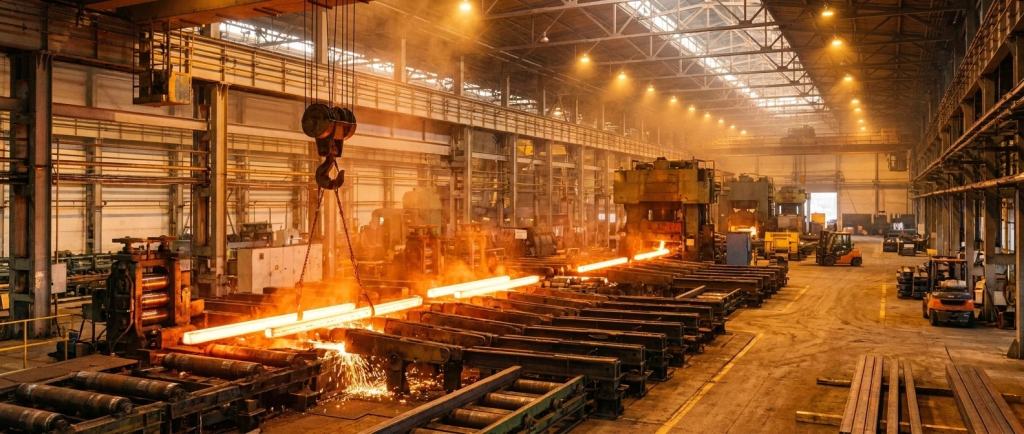
By overcoming chronic energy challenges and imbalances, Khuzestan Steel has shifted its development strategy from "capacity expansion" to "strategic risk management." Focusing on completing the value chain, energy self-sufficiency, and setting production records has made this company a model for sustainability in the steel industry.
Iran remained the world’s tenth-largest producer with approximately 32 million tons of crude steel production in 2025, but behind this position lies a set of structural issues: electricity and gas imbalances, rising energy costs, difficulty in securing stable raw material supply, transportation infrastructure constraints, pressure on profit margins, and tougher competition in export markets. The experience of the year 1404 (2025–2026) also showed that the industry’s main problem is no longer “having capacity”; rather, it is the ability to sustainably and economically utilize capacities.
For this reason, strategic management in a steel company today is measured less by the number of projects and more by the question of whether today’s investments will untie tomorrow’s production knots.
From this perspective, reviewing Khuzestan Steel’s path over recent years takes on a different meaning.
Entering the mining sector to reduce raw material risk; launching Zamzam 3 mega-module and completing Shadegan steelmaking to create balance and deepen the chain; moving toward energy self-sufficiency through the Persian Gulf power plant, the 520-megawatt combined cycle project, and solar plans; localizing thousands of parts and equipment; and on the market side, maintaining and developing exports and seeking new markets. Even in the first half of 1404, the company’s exports reached 472,462 tons, which was 67% higher than the same period.
The common thread of these measures is the shift from day-to-day production management to managing the enterprise’s strategic risks.
The importance of this orientation becomes clearer when we place the cost of imbalances alongside it. According to reports published by the company, energy constraints over four years have taken more than 2,555,000 tons of production and about $1.3 billion in revenue from Khuzestan Steel; at the industry level, too, the energy issue remains the most important threat to production sustainability and profitability.
The management response to such a situation cannot merely be demanding more electricity and gas. Owning the 540-megawatt Persian Gulf power plant, pursuing the Taryana combined cycle power plant, and defining 600 megawatts of solar capacity should be viewed within this framework: converting a chronic external threat into a strategic investment matter. The record of 360,798 tons of steelmaking production in Mehr 1404, after periods of restriction, also showed that whenever the energy barrier decreased, the company’s operational capacity had the ability to quickly return to high production levels.
Thus, the company’s set of measures, rather than being a collection of scattered achievements, are signs of the formation of this very outlook; a management that solves today’s problem but measures investment against tomorrow’s problem.
The future of Iran’s steel will belong to enterprises that recognize the source of their vulnerability before the crisis arrives and rearrange their value chain, energy, technology, and market accordingly; a path of which Khuzestan Steel’s experience in recent years, despite all constraints and imposed costs, has placed significant signs before the industry.