Magna Mining approves restart of Levack copper mine
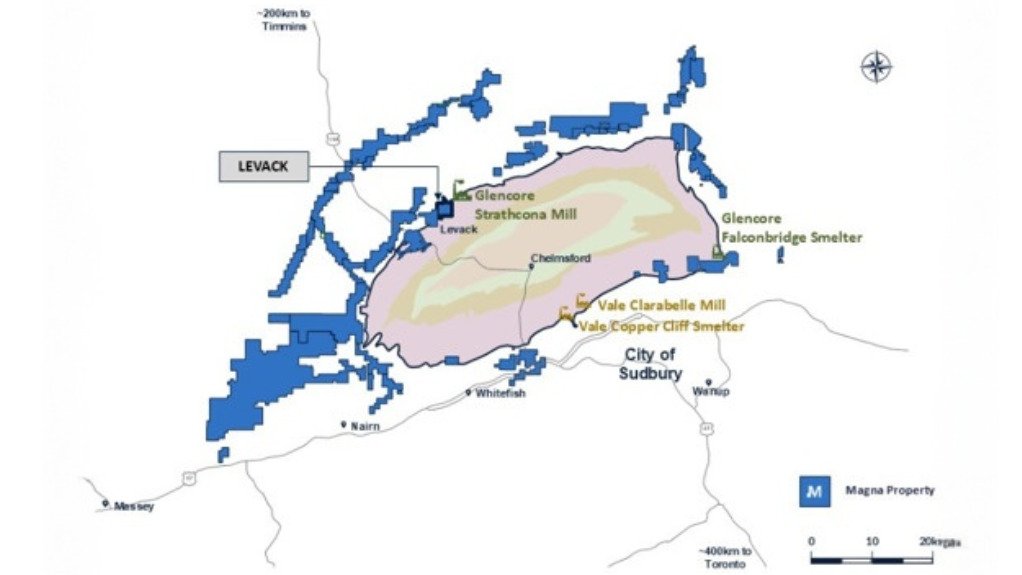
Canadian base metals miner Magna Mining has formally approved the plan to restart its fully-permitted Levack copper mine, in the Sudbury basin, in north-eastern Ontario, following the positive results of a preliminary economic assessment (PEA).
“The PEA demonstrates the Levack mine’s potential as a low capital cost, high internal rate of return (IRR) project with a clear pathway to a rapid ramp-up to commercial production. The low capital intensity reflects the significant capital previously invested in the mine, as well as the current state of its existing infrastructure.
“The mine plan outlined in the study prioritises higher-grade copper and precious metal footwall zones early in the mine life, generating meaningful pre-production revenue and supporting a strong IRR,” comments Magna CEO Jason Jessup.
The PEA estimates initial capital costs from January 1, 2027, to the start of commercial production will be C$70.1-million, after incorporating equipment financing timing effects. This initial capital is estimated to be offset by refundable tax credits of about C$5.6-million and expected pre-commercial production operating cash flow of about C$55.9-million using base case price assumptions, leaving a calculated net initial funding requirement of C$8.6-million.
Further, the PEA estimates payback in 0.6 years with a base case after-tax IRR of 92.4% and an after-tax net present value (NPV) of C$227-million.
Magna notes that the pre-tax cash flows in 2028 and 2029 are estimated to be about C$96.5-million a year. Using September 2026 average commodity prices, the after-tax NPV increases to C$313.6-million and the IRR improves to 115.8%, with average pre-tax cash flows of about C$120.6-million a year in 2028 and 2029.
The PEA is based on underground mining of 5.75-million short tons, with 7.3 years of commercial production and average payable copper-equivalent production of 36.8-million pounds a year at an all-in sustaining cost of $3.71/lb of copper-equivalent.
The mine is expected to reach commercial production in mid-2028.