Heavy 184,000-Point Decline in Tehran Stock Exchange Main Index
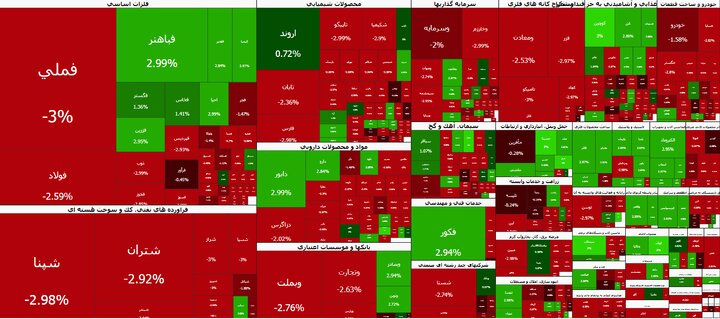
The Tehran Stock Exchange faced heavy selling pressure in Sunday's trading on November 1, 2026, with the main index retreating 184,774 points to 7,654,000 units; simultaneously, a more than 30,000-point drop in the equal-weighted index indicated the spread of the negative wave to all large and small symbols of the capital market.
The capital market experienced a negative, supply-heavy day in today’s trading (November 1), with the main indices of the Tehran Stock Exchange and Iran Farabourse declining simultaneously. The Tehran Stock Exchange main index fell 184,774 points, retreating to 7,654,000 units.
The equal-weighted index, which provides a broader picture of the general condition of listed companies, also fell 30,867 points to the 2,165,000-unit range.
The simultaneous decline of these two indices shows that today’s negative wave was not solely caused by price declines in a few large, index-driving companies; rather, shares of small and medium-sized companies also faced selling pressure.
During today’s trading, 829,131 trades were recorded on the Tehran Stock Exchange, with trading value reaching approximately 32 trillion tomans. The symbols Fmeli, Fars, Foolad, Shepna, Taban, Shabandar, and Shasta were among the symbols influencing the main index.
In the Iran Farabourse, similar conditions prevailed, with the market’s main index falling 916 points to 65,210 units. The number of Farabourse trades was 896,793. The symbols Koghar, Fazar, Aria, Vamapna, Sharanel, Neshkar, and Arfa had the greatest impact on this market’s index trend.
Widespread Decline; Selling Pressure Not Limited to Large Symbols
The notable point in today’s trading is the gap between the decline of the main index and the equal-weighted index. This difference shows that large, index-driving companies bore greater pressure, but the significant decline in the equal-weighted index also indicates that a large portion of the market’s shares were not spared from the selling wave.
On the other hand, the 32-trillion-toman trading value alongside the heavy index declines shows that the market, despite significant trading turnover, has not been able to attract sufficient demand to counter supplies. In other words, trading liquidity does not necessarily mean the presence of effective demand, and in conditions where sellers act with less caution in offering, even high trading value cannot prevent price declines.