Energy Efficiency, New Axis of Competition for Chinese Steelmakers; Baoshan Registers HCR Patent
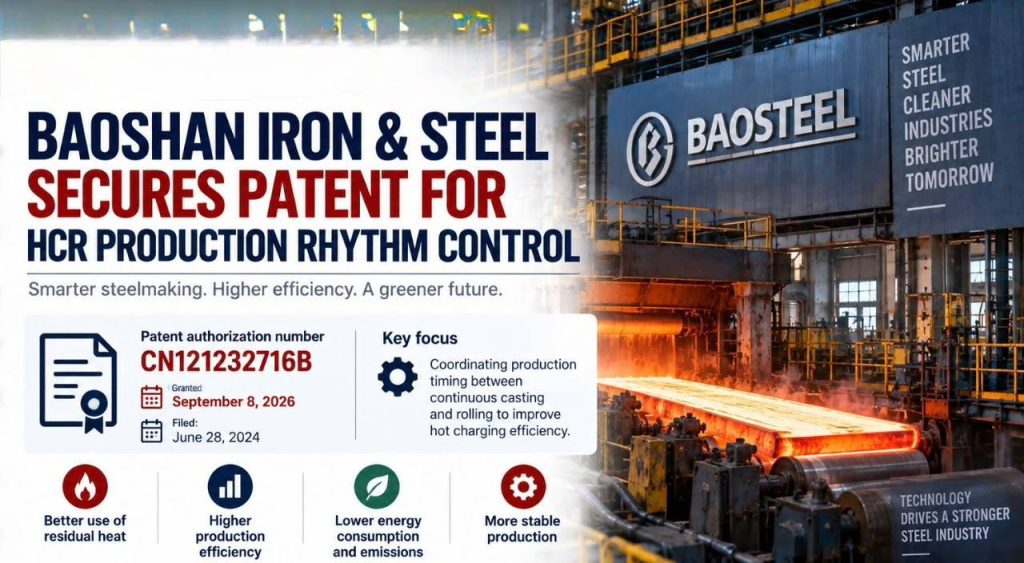
Baoshan Iron & Steel of China has successfully obtained a patent for a method and device for controlling production rhythm in the hot charge rolling (HCR) process—a technology developed to achieve more precise synchronization between continuous casting and rolling, increase utilization of residual heat from slabs, reduce preheating furnace energy consumption, and improve production efficiency.
This move is significant as pressure on steelmakers’ profit margins has elevated the role of cost- and energy-reducing technologies in the steel industry’s competitiveness.
According to a report by Ma’adan News, Baoshan Iron & Steel has secured a patent for its method and device for controlling HCR production rhythm—an invention reflecting this major Chinese steelmaker’s continued path toward smarter, more integrated, and more energy-efficient steelmaking.
According to China’s National Intellectual Property Administration, the patent was finalized on September 8, 2026, under grant number CN121232716B. The initial application for this technology was filed on June 28, 2024.
The core focus of this technology is synchronizing production timing between two key segments of the steelmaking chain: continuous casting and rolling. This is highly important in hot charge rolling (HCR) processes because the shorter and more synchronized the time gap between a slab exiting casting and entering the preheating furnace or rolling line, the greater the possibility of utilizing the slab’s residual heat.
According to the patent abstract, Baoshan’s new system calculates the appropriate start time for the HCR production schedule, determines the latest slab exit time and scheduled times for charging it into the furnace, and aligns material preparation with the casting and rolling rhythm. The method also verifies whether the slab exit schedule and their furnace charging timing are properly synchronized with each other.
The main objective of this technology is to maximize the use of residual heat from continuous casting, accelerate slab transfer and charging into the preheating furnace, and increase slab temperature at the time of charging. Achieving these goals can reduce the need for reheating and lead to lower energy consumption in furnaces.
Improving coordination between casting and rolling, in addition to reducing energy consumption, can help integrated steel units decrease slab temperature loss, fuel consumption, and pollutant emissions while enhancing production process stability. From this perspective, this invention is not merely a limited technical measure but part of the Chinese steel industry’s movement toward digitalization of production planning, process integration, and improved energy performance.
This development comes as competitiveness in China’s steel industry is no longer dependent solely on production capacity or scale of operations; rather, technologies related to digital scheduling, thermal loss reduction, energy management, and smart process connectivity have become more important factors in determining steelmakers’ competitive advantage.
Baoshan Iron & Steel recorded revenue of 160.731 billion yuan and net profit of 5.1 billion yuan in the first half of 2026, placing it among the strong performers among China’s listed steel companies.
As pressure on steelmakers’ profit margins persists, technologies that can shorten process time, increase thermal efficiency, and reduce energy consumption can become one of the key tools for mills to strengthen cost competitiveness.