Higher output, disciplined cost control contribute to record free cash flow for Agnico Eagle
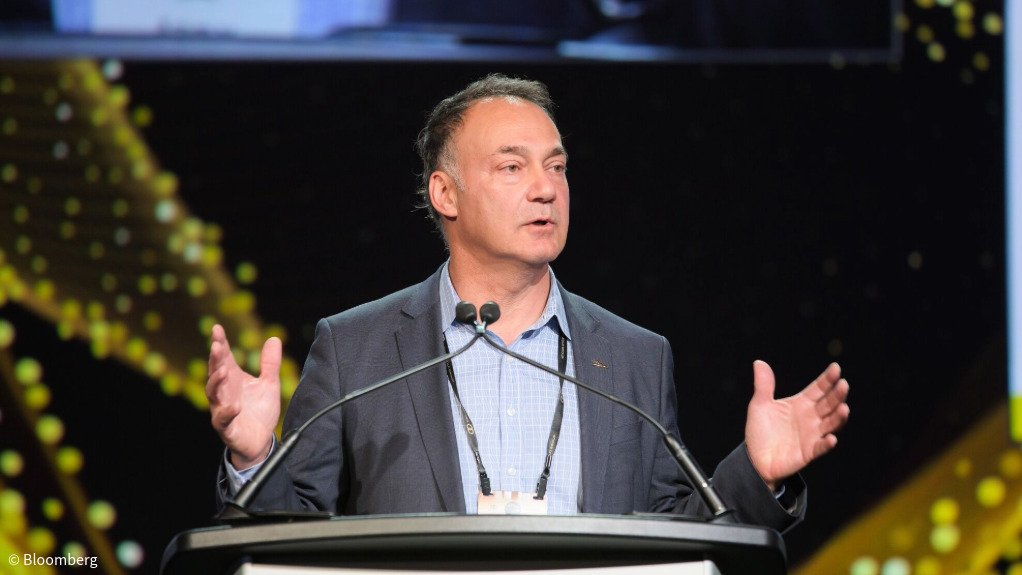
Agnico Eagle Mines delivered a strong second-quarter performance, with better-than-planned production and disciplined cost control driving strong margins and record quarterly free cash flow, CEO and president Ammar Al-Joundi says.
“The strength of our business and our balanced capital allocation approach enabled us to reinvest in future growth, enhance our portfolio through the completion of the regional consolidation in Finland, further strengthen our balance sheet and return a record $625-million to our shareholders through dividends and share repurchases during the quarter.
“Continued progress across our growth projects, supported by positive exploration results, reinforces our confidence in our long-term outlook, while our strong financial position supports our commitment to creating long-term value and delivering strong returns to our shareholders,” he avers.
Payable gold production was 855 816 oz at a production cost of $1 114/oz, total cash costs at $1 054/oz and all-in sustaining costs (AISC) at $1 459/oz for the quarter ended June 30.
The strong operating performance was led by the company’s Detour Lake, Kittilä and Fosterville operations in Canada, Finland and Australia, respectively.
Solid production and disciplined cost control, combined with realised gold prices of $4 483/oz in the second quarter, resulted in record free cash flow.
The company reported quarterly net income of $1.6-billion, or $3.19 a share, and adjusted net income of $1.54-billion, or $3.07 a share.
It generated cash provided by operating activities of $2.14-billion, or $4.27 apiece, and free cash flow of $1.34-billion, or $2.66 apiece.
Agnico increased its cash balance by $352-million to $3.46-billion as at June 30, resulting in a net cash position of $3.27-billion with total debt outstanding of $197-million at period end.
Fitch Ratings upgraded the company’s long-term issuer default rating from BBB+ to A‑ in April.
Expected payable gold production for the full-year remains near the lower end of the guided range of 3.3-million to 3.5-million ounces, reflecting the preliminary redesign of the Barnat openpit at Canadian Malartic that contemplates reduced production following the rock mass movement reported on July 2.
Full-year total cash costs and AISC guidance remain unchanged at $1 020/oz to $1 120/oz and $1 400/oz to $1 550/oz, respectively.
Total capital expenditures (excluding capitalised exploration) are now expected to be between $2.6-billion and $2.8-billion for the full-year, compared with previous guidance of $2.2-billion to $2.4-billion, reflecting the approval of construction activities at Hope Bay, in Canada, as announced on May 19.
Capitalised exploration guidance remains unchanged at $290-million to $330-million.