Competition for water resources a risk to the global energy transition
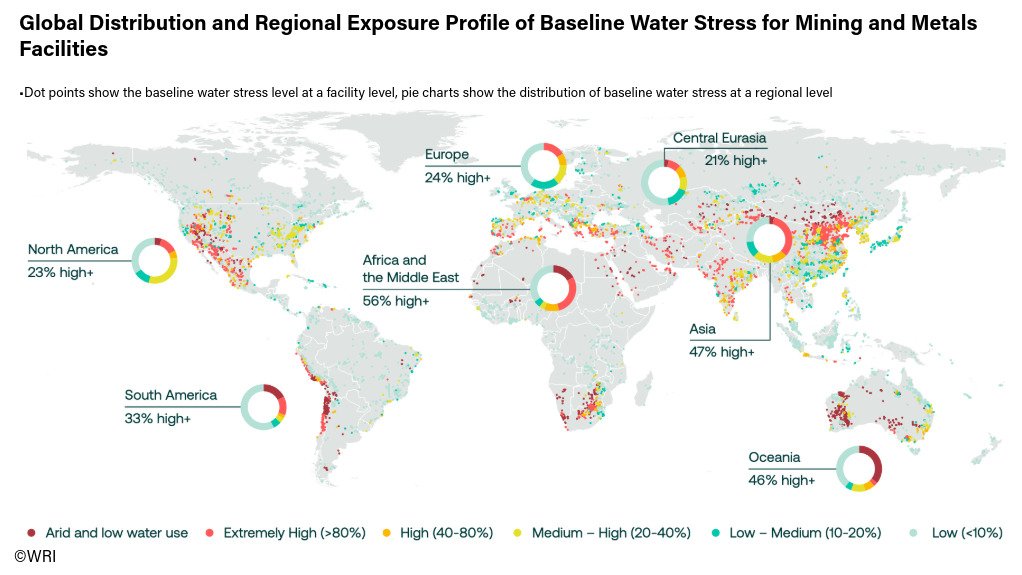
Mining and metals advocacy group the ICMM warns that water availability could, in many regions, act as a constraint on the development of new mines and related facilities, particularly for the production of metals and minerals, such as platinum group metals, chromium, manganese, aluminium and steel, that are key to the energy transition.
In its ‘Global Mining and Metals Water Dataset’ report, published on July 22, the ICMM states that competition for finite water resources is not a future concern, but a present operational reality and a structural constraint on the expansion of the mining and metals sector, as well as the pace of the energy transition itself.
“Our research shows that water is already a material issue for the mining and metals sector. If water risk exposure is not better understood and managed across the wider economy, we risk sleepwalking into a major constraint on the energy transition. This is why leading mining companies including ICMM members have embedded water stewardship principles and practices, to manage water in ways that are socially equitable, environmentally sustainable and economically beneficial,” ICMM data and research director Dr Emma Gagen says.
She adds that this report, which draws on the ICMM’s Global Mining Dataset of 12 000 facilities and which was produced in partnership with the World Wide Fund for Nature and the the World Resources Institute (WRI), provides the first comprehensive, cross-commodity global assessment of how the mining and metals sector is exposed to water risk.
“By developing credible and accessible data, ICMM aims to support more informed decision-making by policymakers and investors on water risk exposure, helping to manage the demand created by the energy transition. This dataset is a starting point for others to explore, use and collaborate with us to continue improving the collective picture of water risk across the industry.”
“With the global surge in the mining and production of critical minerals, driven by the energy transition, countries are grappling with how to meet the rising demand while promoting responsible mining activities. Responsible mining starts with shared access to credible, publicly available data on where water risks are greatest.
“The WRI welcomes the ICMM’s contribution as a meaningful step toward providing governments, communities, investors and companies with a foundation data base needed to help plan and act across the full value chain,” comments WRI Food, Land and Water Programs global director Crystal Davis.
INSIGHTS
In the report, the ICMM discusses five key insights. Firstly, it points out that 30% of all mining and metals facilities operate in areas of high extremely high water stress and a further 8% in arid areas where water is functionally unavailable.
Of the 38% of facilities exposed to high or extremely high water stress or located in arid areas where water is functionally unavailable, more than 70% are also located in areas of high or extremely high water depletion levels that affect 27% of all facilities globally, it adds.
Saudi Arabia, Chile, Iran and Mexico are cited as global water depletion hotspots, with 100% of mining and metals facilities in Saudi Arabia exposed to water depletion. Ninety-six per cent of facilities in Chile are exposed to water depletion and 81% of facilities in Iran and Mexico.
Further, China accounts for the largest number of mining or metals facilities in water stressed basis, at 59%. The report outlines that 45% of the mining and metals facilities in the Asian country are exposed to extremely high baseline water stress, 10% to high baseline water stress, while 4% of facilities are located in arid and low water use regions.
Secondly, the report states that 27% of all mining and metals facilities are exposed to high drought risk, making drought the second most prevalent physical water risk indicator in the dataset. Eighty-one per cent of facilities in Africa and the Middle East are in areas of high or very high drought exposure.
The ICMM points out that, in many countries, including Zambia, Ghana and Uzbekistan, drought exposure is near-total. In South Africa, meanwhile, 96% of facilities are exposed to high or extremely high drought risk.
The commodities most at risk owing to drought are PGMs, chromite and diamonds.
Thirdly, 14% of all mining and metals facilities are exposed to high or extremely high flood risk. The report shows that flood risk exposure is unevenly distributed across regions, with Indonesia’s exposure rate the highest of all regions, at 32%.
Among the commodities, alumina refining (27%), aluminium smelting (24%), molybdenum production (25%) and steel production (27%) all face above-average flood risk exposure.
Fourthly, the report states that 16% of mining and metals facilities are exposed to high or extremely high interannual variability. Exposure is greatest in Australia, at 79%, and Oceania, at 74% – more than double the exposure rate for the next most exposed region Africa and the Middle East (28%).
The ICMM notes that coal, copper, gold, iron-ore and nickel all face interannual variability rates well above the global average in Australia.
Further, it points out that, at the global commodity level, facilities producing diamonds (46%), barium (37%), heavy mineral sands (37%) and manganese (31%) all face interannual variability exposure rates well above the global average.
Lastly, the report shows that 66% of global mining and metals facilities are exposed to a high risk for at least one physical water risk indicator, while 5% of facilities face a high risk on three or more indicators concurrently, “meaning multiple independent physical water pressures converge on the same facilities”.
The ICMM states that water can be both an enabler of and a constraint on the mining and metals production required to support the global energy transition.
“Recognising this, water risk exposure must be treated as a critical strategic issue. Effective responses will depend on coordinated efforts across governments, investors and industry,” the group says, adding that, without coordinated
action across industries and governments, water risk will increasingly act as a bottleneck on the supply of critical minerals and metals needed for the global energy transition.