Sangan Steel’s Environmental Achievements; From 80% Water Recycling to Wind Energy Development
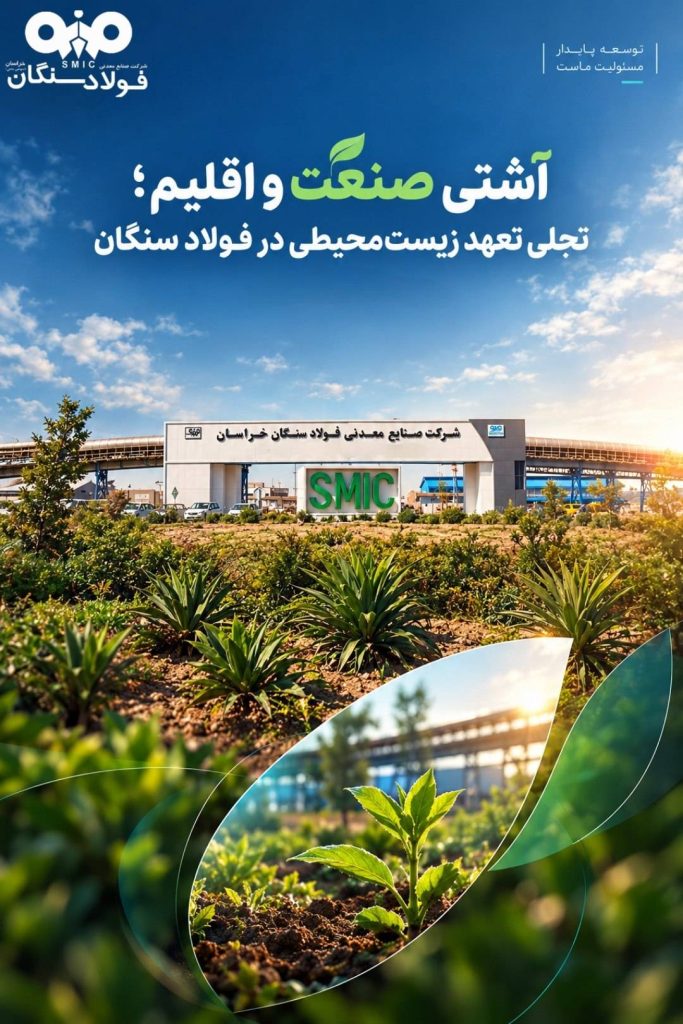
Sangan Steel Mineral Industries Company implemented a model of industry-environment coexistence with 80% water recycling, online dust collector monitoring, planning for a wind power plant, and green belt development in the Khaf region.
The Sangan Khaf region, long recognized as one of the richest and most strategic iron ore reserves in the Middle East, has witnessed a fundamental transformation in management’s approach to environmental issues in recent years—a transformation that defines climate protection not merely as a legal requirement, but as a fundamental, strategic, and identity-building responsibility across the entire pellet and concentrate production value chain, turning the slogan of reconciling industry with nature into a strategic and tangible program, such that environmental protection is considered one of the fundamental pillars of Sangan Steel’s social responsibility document.
Water resource management, as the most critical issue in the eastern climate of the country, is the main focus of this industrial complex’s recent successes; by employing the latest modern technologies and developing advanced industrial treatment plants, the water cycle in the company’s plants has been designed so that its recycling has reached 80% and a high efficiency rate, and the production lines’ dependence on the region’s water resources has been reduced to a minimum—a smart measure that, in addition to guaranteeing production sustainability, has prevented the reduction of resources and damage to the region’s ecosystem and, beyond that, has led to its strengthening, which is a decisive step in restoring hydrological balance.
Alongside water resource management strategies, dust emission control and significant improvement of ambient air quality are among Sangan Steel’s other outstanding achievements; by designing and deploying the most modern filtration systems, advanced dust collectors, and systematic covering of conveyor belts and stockpile warehouses, the dispersion of suspended particles has reached levels far below stringent national and international standards—an approach in which online and real-time monitoring of stack emissions, directly linked to the monitoring systems of the Environmental Protection Organization, continuously confirms the transparency, health, and sustainability of its production processes.
Sangan Steel’s fundamental move toward clean energy use is another important measure these days; focusing on energy consumption efficiency, optimizing thermal processes, and targeted planning for utilizing renewable energy capacities—particularly the construction of wind power plants in the suitable plains of Khaf—the company has drafted a comprehensive roadmap and is a pioneer in realizing the goals of clean energy use and sustainable power generation.
The extensive and impressive development of the green belt and sustainable afforestation around production sites and surrounding areas is another golden page in this complex’s climate record; by planting thousands of saplings suited to climatic conditions and using treated wastewater in drip irrigation systems, not only has a green and pleasant appearance been given to the harsh industrial environment, but potential sources of local dust have been stabilized and natural habitats for the region’s animal and plant species have been revived.
Comprehensive industrial waste management with emphasis on the circular economy also constitutes an important part of this brilliant record; through precise separation of tailings, maximum recycling of waste, and applied research for utilizing mineral waste in downstream industries such as building materials and road construction, a comprehensive model of reducing the ecological footprint has been realized.
In conclusion, this balance of proud achievements and intelligent environmental performance shows that Sangan Steel Mineral Industries Company, with deep belief in sustainable development, has been able to turn the coexistence of industrial value creation with climate protection into a sustainable reality; a brilliant model that guarantees employment prosperity, preserves the country’s economic authority in supplying the steel chain, and at the same time, unreservedly protects the ecosystem heritage for future generations of Iran.