Reduction in Logistics Costs with a 9-Fold Jump in Rail Transport at Hormozgan Steel
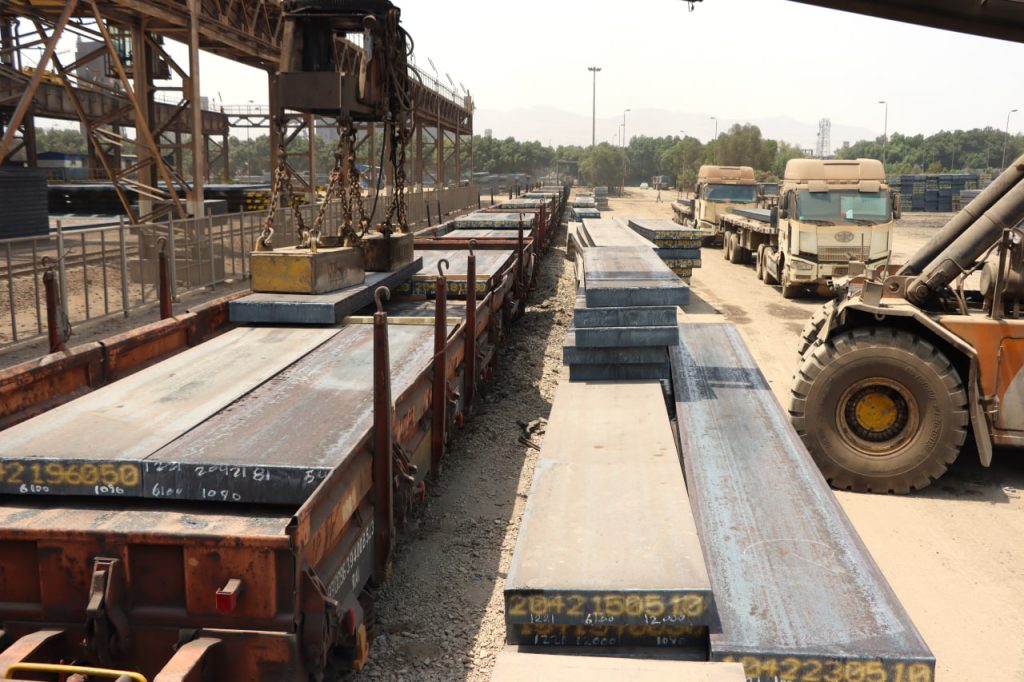
By utilizing rail transport capacities and synergy with Mobarakeh Steel, the share of rail transport for Hormozgan Steel's products in the first 5 months of the Iranian year 1405 (2026) saw a 9-fold jump from 5% to 45.9%; an achievement that has reduced logistics costs and strengthened supply chain stability.
Yaser Shahriari, Head of Casting and Product Dispatch at the company, announced this news and said: In past years, Hormozgan Steel always had suitable rail loading infrastructure; however, due to the lack of unloading equipment at customer locations and logistical constraints on the demand side, the share of rail transport from the company’s total shipments was limited to less than 5%. This is while rail transport, compared to road transport, in addition to reducing logistics costs, offers numerous advantages including greater safety, reduced greenhouse gas emissions, and lower fleet depreciation rates.
He added: Following Hormozgan Steel’s joining the Mobarakeh Steel Group and the creation of synergy in the supply chain, access to the rail unloading infrastructure of Mobarakeh Steel and shared customers was provided. This structural transformation paved the way for the actualization of the potential rail transport capacities, and its results became clearly evident in the first months of 1405. In this way, a potential capacity that had been neglected for years, with a 9-fold jump in 1405, became one of the drivers of cost reduction and increased supply chain stability.
First Six-Month Performance of 1405
Shahriari noted: According to official statistics, from the beginning of Farvardin to the end of Mordad 1405 (March–August 2026), out of a total of 427,000 tons of products shipped, over 196,000 tons were transported through the rail network. Thus, the rail share of total transport reached 45.9%, which compared to the less than 5% share of previous years, represents a 9-fold growth.
The Head of Casting and Product Dispatch at Hormozgan Steel stated: By transforming a potential capacity into an actual one, Hormozgan Steel has not only improved its cost structure but has also solidified its position as a logistics-oriented and agile enterprise in the country’s steel industry. Continuing this path will require intelligent investment in developing customer infrastructure and increasing strategic cooperation with Mobarakeh Steel.
Financial and Strategic Achievements
Mohammad Reza Tusheh, Acting Head of Casting and Product Dispatch at Hormozgan Steel, also elaborated in this regard: From the perspective of financial and logistics management, this jump has brought positive consequences for the company, including the following:
- Reduction in transportation costs: Preliminary estimates show that the cost of transporting each ton of product by rail, depending on the route, is between 20% and 35% lower than road transport. With the movement of 196,000 tons of product via rail, significant direct and indirect savings have been recorded in the company’s logistics budget.
- Increased delivery reliability: Rail transport is less affected by seasonal constraints, road traffic, and fuel price fluctuations, making delivery times more predictable.
- Reduction of operational risks: Diversification of the transportation portfolio has reduced the company’s dependence on the road fleet and increased the supply chain’s resilience against potential crises (such as truck shortages or freight rate fluctuations).
- Environmental sustainability and social responsibility: Rail transport produces less CO₂ per ton-kilometer. This shift in approach will be an effective step toward achieving sustainable development goals and the company’s ESG reporting.
He concluded: Given the upward trend in rail transport in the first half of the year, it is predicted that if coordination with customers who have rail unloading infrastructure continues and inter-company cooperation with Mobarakeh Steel is expanded, the share of rail transport will exceed the 50% threshold by the end of 1405. This success demonstrates a model of intra-group synergy that can serve as an inspiration for other subsidiary companies as well.