50% US and EU Tariffs Put POSCO Steel Exports Under Pressure
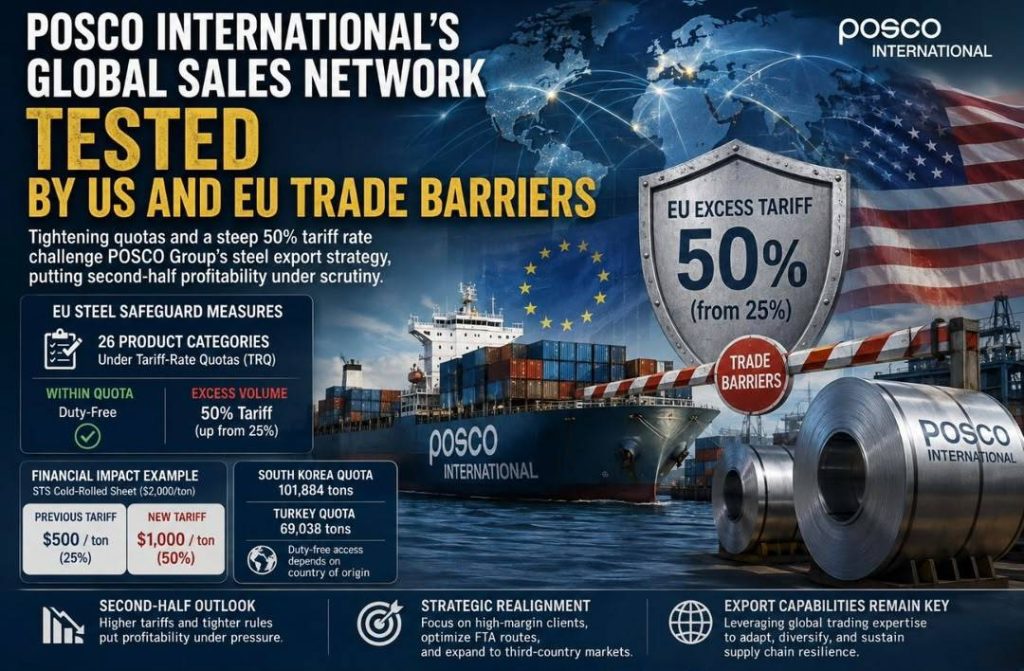
Tighter trade restrictions imposed by the United States and the European Union, ranging from stricter quotas to 50% tariffs on excess steel imports, are putting POSCO Group's global export strategy under pressure and raising challenges for profitability in the second half of the year.
POSCO Group’s global steel export strategy is facing a major test as the United States and the European Union systematically tighten their trade restrictions.
POSCO International, which handles more than 70% of the group’s total steel export volume, continues to play a central role in its overseas sales network. However, industry analysts say country-specific quotas, high tariffs and stricter rules of origin have created structural barriers that cannot be fully offset by trading capabilities alone.
EU Introduces 50% Tariff on Excess Steel Imports
Following the implementation of strengthened EU steel safeguard measures in July, country- and product-specific tariff-rate quotas (TRQs) were introduced across 26 steel product categories.
Imports within the allocated quotas remain exempt from tariffs, while volumes exceeding the quotas are subject to a 50% tariff—double the previous 25% rate.
For example, for cold-rolled stainless steel (STS) products priced at $2,000 per tonne, exceeding the quota previously resulted in a tariff of $500 per tonne. Under the new regulations, the tariff has increased to $1,000 per tonne.
South Korea’s annual quota for cold-rolled STS products has been set at 101,884 tonnes, compared with 69,038 tonnes for Türkiye. As a result, tariff-free access to the European market increasingly depends on the country of origin rather than simply a supplier’s sales capacity.
Stricter Rules of Origin
The European Union is also considering stricter rules of origin that would trace the origin of steel products back to the crude steel production stage.
Under the proposed approach, downstream processing activities—such as cold rolling in Türkiye using South Korean raw materials—may no longer be sufficient to overcome trade restrictions.
A POSCO official has also indicated that the complementary role of the group’s Turkish subsidiary is expected to become increasingly limited.
Sales Rise in Europe and North America
According to the data, POSCO’s sales volume in Europe increased by 21.9% in the first half of the year to 1.67 million tonnes, accounting for 26.8% of its total sales.
Sales volumes in North America also rose by 48.6% to 520,000 tonnes. In contrast, sales volumes in Asian and Middle Eastern markets declined significantly.
As the increase in European steel exports during the first half occurred before the full implementation of the new safeguard regulations, maintaining both sales growth and profit margins in the second half is expected to become a major challenge for POSCO.
Meanwhile, the growing tariff burden in North America has made it more difficult to translate higher sales volumes directly into stronger profitability.
POSCO Redirects Its Export Strategy
To mitigate the impact of tighter trade restrictions, POSCO plans to prioritize its EU export quotas for strategic customers with higher profit margins. The company also intends to optimize market access through free trade agreement (FTA) partners in cooperation with industry associations.
Excess volumes are expected to be redirected toward the domestic market and emerging markets in third countries.
POSCO executives have stressed that the group’s trading capabilities will remain critical in identifying alternative markets and maintaining the stability of its global supply chain.