Creecy says rail reforms on track as South Africa targets freight recovery
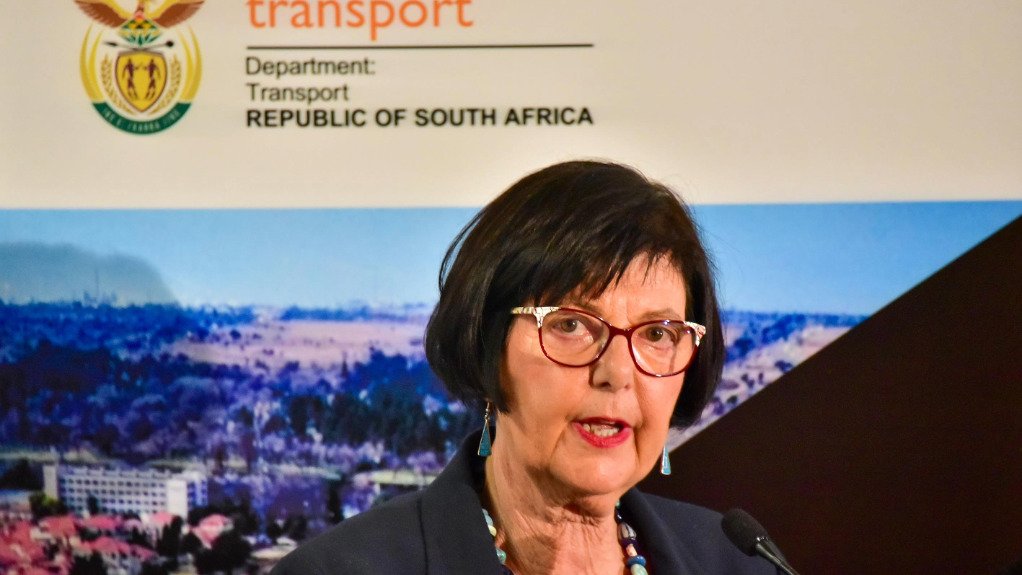
Transport Minister Barbara Creecy has expressed confidence in South Africa’s rail reform programme, highlighting that the government is committed to restoring the country’s rail network, attracting private investment and embedding reforms in law to ensure their continuity beyond the current administration.
Creecy provided these insights during a Creamer Media transport webinar titled ‘Reform and Recovery: Are South Africa’s rail reforms taking shape and what’s next?’, held on October 14.
The webinar was facilitated by industry association Steel and Engineering Industries Federation of Southern Africa CEO Tafadzwa Chibanguza and featured industry representatives including electromechanical equipment company ACTOM Group CEO Mervyn Naidoo, railway infrastructure company Afri-Track Railway Construction project manager and adviser Leon Steyn, rail services company Traxtion CEO James Holley and global lubricant supplier Shell Lubricants technical and services manager Mpho Mokwena.
Creecy said freight rail capacity had increased by more than 20-million tonnes over the past two years, as the government sought to improve the efficiency, affordability and reliability of freight rail transport.
“We are now on a recovery trajectory, having increased capacity. We want to make rail more efficient, more effective and, ultimately, more affordable. We are on track, and we hope that, as time moves on, we’ll be moving with ever greater momentum,” she noted.
The Minister said the introduction of private train operating companies (TOCs) was central to the reforms, alongside an improved performance by State-owned Transnet Freight Rail, infrastructure investment and the establishment of an independent transport economic regulator.
South Africa’s rail system had experienced an almost complete collapse in the early 2020s, she said, making the recovery of capacity and the introduction of competition essential to restoring the network’s contribution to economic growth.
The government had assessed and approved 11 TOCs, which were expected to begin operations in April 2027 and, ultimately, contribute an additional 24-million tonnes of freight capacity on the Transnet network.
Further, Creecy said the fourth iteration of the Rail Network Statement provided greater certainty for private operators through a more flexible capacity allocation process, improved transparency on available network capacity and an extension of access agreements from 10 to 15 years.
The longer agreements were intended to support investment in rolling stock by providing private operators with greater certainty over their access to the network.
However, she cautioned that the pace of reform needed to account for the complexity of the broader transport system.
“We can all agree that the reforms we’re introducing should have been introduced 20 years ago,” she said, adding that comparable reform processes in other countries had taken about 20 years to implement.
“I don’t think we can go much faster than we’re going and keep the whole ecosystem together,” she said.
Creecy also emphasised the importance of securing the reforms through legislation and long-term planning, as the government intended to use the National Rail Master Plan and a proposed Rail Bill to entrench the changes and prevent them from being reversed by future government administrations.
The master plan identifies a core rail network on which the government will focus investment, while allowing private operators to explore opportunities on other lines for mining, agriculture and tourism.
Within the next decade, Creecy said, the core rail network should be in substantially better condition, with improved maintenance, functioning signalling systems and measures to address safety challenges such as vandalism.
She also anticipated a gradual expansion in containerised freight, thereby increasing the importance of the corridors connecting Gauteng with Durban and Cape Town.
Government is also investigating the potential return of long-distance passenger rail, which is managed by the State-owned Passenger Rail Agency of South Africa, while also considering the need to integrate rail with road, air and maritime transport.
On localisation, Creecy said South Africa should build on its existing industrial capabilities rather than start from scratch. She pointed to domestic train manufacturing, which used South African steel, and the potential to expand locomotive and wagon maintenance and production through existing industrial facilities.
South Africa had been designated the African Union’s train production centre for the continent, she added, presenting an opportunity to develop manufacturing capacity that could serve regional markets.
She also noted that development finance institutions could play a role in bringing together the necessary financing to support such localisation initiatives.
INDUSTRY VIEW
Meanwhile, providing an industry perspective, Naidoo pointed out that South Africa retained substantial engineering and manufacturing expertise that could support the recovery of the rail industry, despite years of reduced activity.
“South Africa has an extensive engineering capability. Prior to democracy and during the isolation period, South Africa was self-sufficient across all areas. We built our own locomotives, we built our own infrastructure for those locomotives, the ports, the power stations and a whole range of other things, he said.
Naidoo also argued that infrastructure investment should support local procurement, technology transfer and the development of domestic supply chains, while ensuring that local products remained internationally competitive.
Additionally, Steyn urged government to prioritise the repair of high-volume, high-revenue railway corridors rather than attempt to rebuild the entire network all at the same time.
“The Transnet Rail Infrastructure Manager is doing their utmost best to bring the railway [infrastructure] back to standard, but we should start slowly. Once a section of a railway line has been prepared, we will start using it.
“We cannot now spend R129-billion to improve the railway lines. That is far too much and it would take many years to do that,” he argued.
Holley said the direction of the reforms had helped underpin the company’s decision to invest in 46 locomotives for South Africa but warned that substantial further investment would depend on the commercial viability of rail operations.
“We completely support the direction that the Department of Transport has taken. We believe the policy is very well conceived and it most certainly follows international best practice,” he said.
Holley also noted that poor infrastructure conditions, outdated operating systems and uncertainty over service levels remained obstacles to securing financing for private-sector investment.
Moreover, he emphasised the importance of lifecycle maintenance, arguing that the long-term servicing of locomotives offered significant opportunities for local suppliers and more sustainable industrial activity.
Mokwena said an efficient rail system was essential to enabling mining, agriculture and manufacturing companies to transport goods to processing facilities and export markets.
“Transport infrastructure plays a very critical role in driving our economy forward. Without a functioning rail system, mines can’t get their products onto the rail for local beneficiation or for exports,” he said.
Chibanguza emphasised the importance of an efficient rail logistics network in supporting economic activity and connecting producers to markets.
“The rail logistics sector is important to the economy. It is the oxygen for economic activity and an efficient logistics network in essence links production to markets.
“Inefficient logistics becomes a tax on the economy and the fact that we are on this repair agenda is a welcomed development,” he highlighted.