Copper 360 intersects mineralisation early at Rietberg
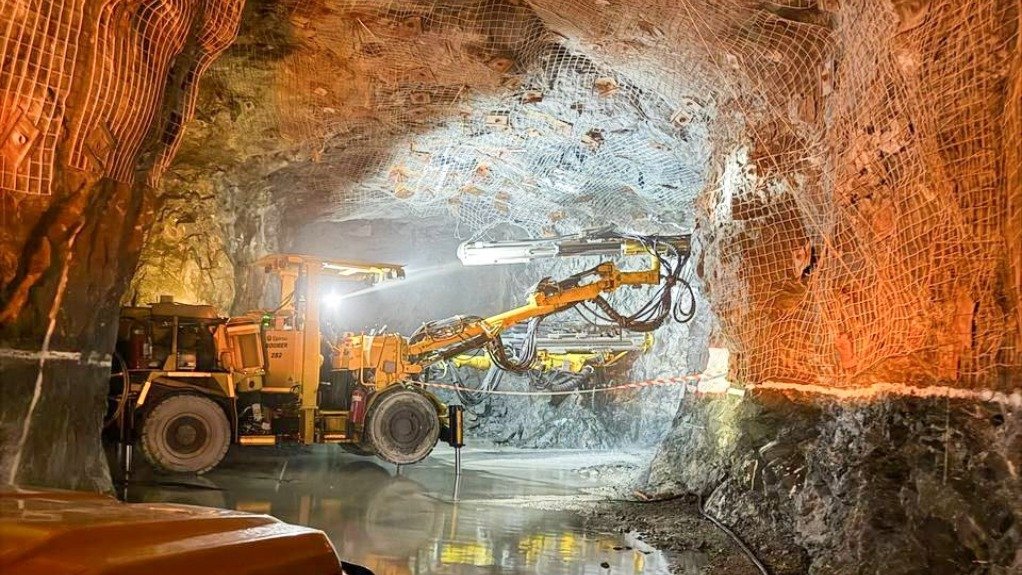
Copper 360 advises that the incline at the Rietberg underground mine, in the Northern Cape, has intersected copper sulphide mineralisation about 16 m before reaching the planned 300 Level (300L) elevation.
This is earlier than expected from the company’s geological model and could represent a new mineralised body, it highlights.
Assays from bulk sampling of the intersection have returned representative grades ranging between 0.48% and 1.50% total copper.
The intersection was made on October 6, and management immediately followed up with geological mapping and sampling.
The mineralisation is hosted in the mafic rocks of the Koperberg Suite, with visible bornite and chalcopyrite.
The planned 400 to 300 Level incline has progressed through this intersection, exposing about 6 m of mineralised mafic rocks.
To obtain representative samples, two composite samples were collected from the stockpile of the mineralised material.
The samples were crushed to –10 mm, homogenised by coning and quartering and subsequently submitted for assay.
Samples were assayed at QLS Laboratory (unaccredited) in Springbok for total sulphide copper.
No acid-soluble analysis was done since no oxide copper minerals were observed and the intersection is far below the known oxide and transition zones, Copper 360 points out.
Quality control samples were included, and all returned results fell within acceptable industry limits.
The company explains that the earlier-than-expected intersection may indicate that the mineralisation extends beyond its currently modelled limits, or that a potential “offshoot” was intersected.
Some legacy borehole intersections (data) are available in proximity.
The company says it will test this through further mapping and face sampling and will update its geological model accordingly.
The intersection does not change the company’s mine plan.
Copper 360 will continue to establish the 300L according to its original layout.
“Reaching ore earlier than expected is significant. It tells us the ore zone possibly extends further than our model showed or that another potential mineralised body is present,” CEO Gordon Thompson says.
“We will continue the investigation and stockpiling this fringe ore while we continue towards the expected higher-grade zone. Our incline development remains on schedule, so this is a positive development.
“The bornite and chalcopyrite showing in the sidewalls, now confirmed by the assays, is exactly what we have been working towards,” he adds.