Corporate PPAs to outpace public procurement in South Africa for first time in 2026
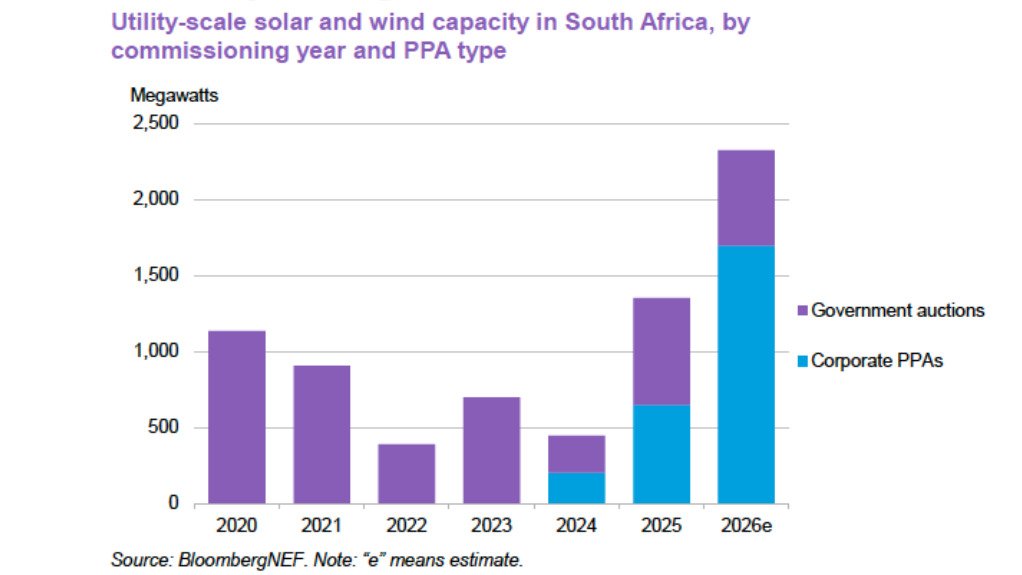
Corporate power purchase agreements (PPAs) are set to drive more utility-scale renewable additions in South Africa than government auctions for the first time in 2026, a new publication by BloombergNEF (BNEF) states.
In its ‘South Africa Transition Factbook 2026’, BNEF says it expects corporate buyers to support 73% of the 2.3 GW of anticipated solar and wind additions.
“Private clean-power procurement is becoming a defining feature of South Africa’s electricity market,” BNEF states, while indicating that transmission capacity is now emerging as a key constraint on further growth.
Since 2020, corporates have signed contracts to procure some 5 GW of clean power.
“Corporate demand has been growing since the cap on private power projects was removed in 2023. Corporate PPAs supported around 670 MW, or 48%, of the 1.4 GW tracked in 2025, with major buyers including Sibanye Stillwater, Rio Tinto, Tronox, Air Liquide and Sasol.”
Meanwhile, BNEF says corporate PPAs are also poised to remain the main driver of renewables through to the end of the decade, with 90% of respondents to BNEF’s South Africa Corporate PPA Price Survey 2026 expecting to sell more through PPAs than through the South African Wholesale Electricity Market (SAWEM).
The launch of the SAWEM has been delayed and the market is expected to be rolled out in stages from the second quarter of 2027.
The price survey also shows that the market expects average solar PPA prices to fall to R848/MWh in 2026 and onshore wind PPA prices to rise marginally to R1 104/MWh.
Solar PPAs in South Africa averaged R935/MWh from 2024 to 2025, compared with R1 102/MWh for onshore wind, reflecting the higher costs and stronger generation profile of wind projects.
The 2026 price differential, BNEF adds, reflects the falling value of solar to offtakers that have already contracted solar and that place less value on additional power delivered during sunny hours.
The factbook, which includes energy scenarios for South Africa to 2050, states that coal will remain central to the power system for years, but that solar, wind and storage will increasingly shape its future.
“Coal supplied 78% of South Africa’s electricity in 2025, down from 90% in 2015. In BNEF’s Economic Transition Scenario, power generation rises 35% to 319 TWh by 2050, as solar and wind expand to supply 69% of annual generation, while coal falls to 21% as aging plants retire and the coal fleet shrinks.”