Boss withdraws Honeymoon EFS
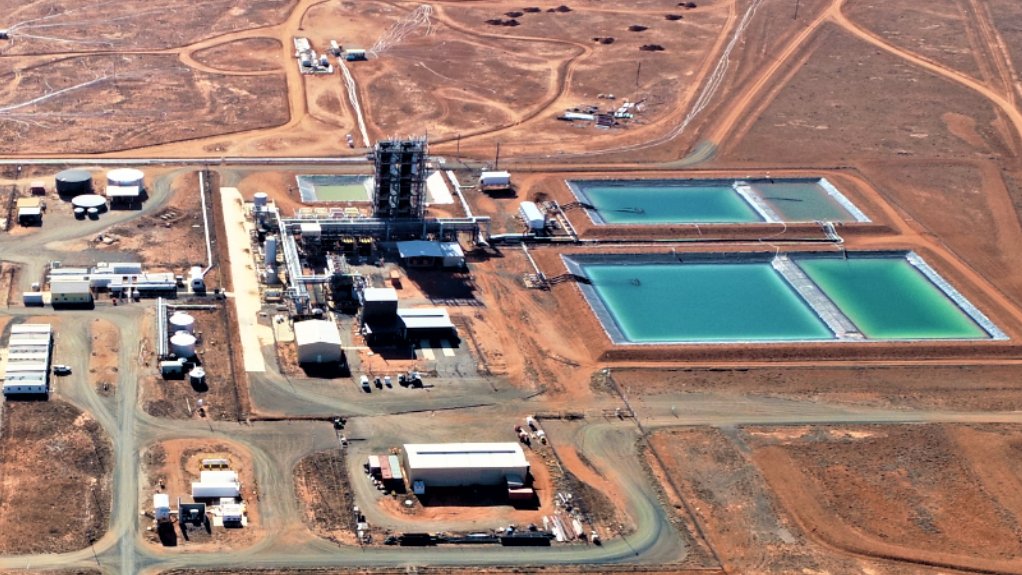
Uranium producer Boss Energy has formally withdrawn the 2021 enhanced feasibility study (EFS) for its Honeymoon in-situ recovery operation in South Australia after a detailed review flagged material deviations from the assumptions underpinning the study, particularly from the 227 financial year onwards.
The company on Thursday said the Honeymoon review had identified “an expected material and significant deviation from the assumptions underpinning the company’s 2021 EFS”, driven by less continuity of higher-grade mineralisation, limited overlap of mineralised zones, lower leachability and smaller wellfields. As a result, Boss advised that the EFS should no longer be relied upon as a guide to future operational performance.
Despite the longer-term reset, Boss confirmed there has been no change to its 2026 financial year production and cost guidance and that it remains on track to deliver 1.6-million pounds of drummed uranium oxide at a C1 cost of A$41/lb to A$45/lb and an all-in sustaining cost (AISC) of A$64/lb to A$70/lb.
Boss MD Matthew Dusci said the review outcomes were disappointing, but had helped clarify a potential pathway forward for the Honeymoon operation.
“Work undertaken on the Honeymoon review has provided Boss with an updated understanding to indicate that execution of the wellfield design as set out in the EFS would be expected to result in a material and significant deviation from the EFS from the 2027 financial year in terms of life of mine production and cost,” he said.
In response, Boss has initiated a new feasibility study to assess an alternative wide-spaced wellfield design, which the company believes could better optimise the Honeymoon resource and asset base. The concept-stage design is expected to be evaluated through a series of accelerated work programmes, with an initial update due in the first quarter of 2026, a scoping study targeted for the second quarter of 2026 and completion of the new feasibility study in the third quarter of 2026.
“Although Boss acknowledges this disappointing outcome, the Honeymoon review and delineation drilling programmes have enabled the identification of a potential pathway forward through a new wide-spaced wellfield design,” Dusci said.
“While additional work is necessary to finalise a new feasibility study, this development presents an opportunity for Boss to potentially lower operating costs, optimise production profiles, and extend mine life compared to the current wellfield design.”
Boss said a wide-spaced wellfield design could potentially deliver lower costs and improved lixiviant grades by increasing leaching time, reducing reagent use and enabling wellfield infrastructure to be utilised over a larger surface area and more uranium under leach.
The company has also initiated work to bring the Gould’s Dam and Jason’s Deposit satellite deposits into the production profile, with an updated resource model and further details expected in the first quarter of 2026. Successful implementation of the wide-spaced wellfield design could improve recoverability and cost structures at these satellite deposits.
“It has been Boss’ expanded wellfields team with international ISR expertise that has identified the wide-spaced wellfield design. We believe that the Honeymoon deposit has the characteristics required to make it amenable to this new design,” Dusci said.
“If successful at Honeymoon, this style of wellfield design would be used, and could potentially improve resource recoverability and cost structure at the Gould’s Dam and Jason’s Deposit satellite deposits.”
Boss reported a robust balance sheet, with A$212-million in cash and liquid assets as at September 30, 2025, which it said would enable the company to self-fund the new feasibility study, a potential change in wellfield design and the early development of the satellite deposits.
“Importantly Boss remains in a strong financial position and has the capacity to self-fund a potential change to a wide-spaced wellfield design and bring Gould’s Dam and Jason’s Deposit into the production profile,” Dusci said.
Looking ahead, Boss said 2027 production and costs are expected to be similar to 2026 based on the current wellfield design, although AISC is expected to be about 15% higher owing to a higher proportion of sustaining capital, pending the outcomes of the new feasibility study.