Masterclass unpacks global mining waste opportunity
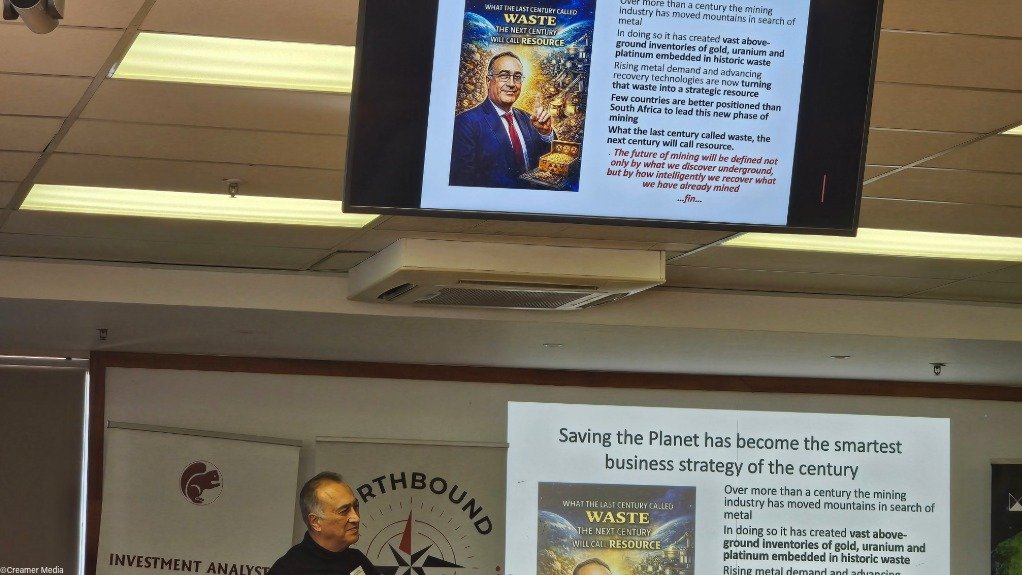
As traditional ore grades continue to decline and global demand for critical minerals increases, historic tailings dams and mine waste deposits present strategic, high-value resource assets, with the potential to turn mining waste from an environmental liability into a multitrillion-dollar economic opportunity, and South Africa stands to benefit from this with its resources.
This was noted by Northbound Processing MD Dr Duarte da Silva, presenting at the Investment Analysts Society of South Africa Masterclass: “Circular capitalism: unlocking the $3.4-trillion opportunity in mining waste”, at the University of the Witwatersrand, on May 6.
Da Silva advocated for “circular capitalism”, whereby environmental restoration and economic value creation reinforce each other.
He averred that circular economies offered a way to reconcile growth with physical limits – not by abandoning capitalism, but instead, by improving how capital was preserved and resources were used.
He emphasised that, globally, there were considerable tailings dams and waste rock dumps, which were historically regarded as environmental liabilities, but now, the materials were being increasingly recognised as repositories of valuable metals that earlier technologies could not recover.
Da Silva underscored the significance of acting now, with global demand rising sharply and ore grades declining.
He elaborated that the energy transition, the digital and technology economy and rising global living standards were driving demand for metals. Moreover, gold demand remained structurally supported by central-bank buying, emerging market wealth growth and its role as a monetary hedge.
Also, platinum group metals (PGMs) remained essential for catalytic converters, hydrogen technologies and specialised industrial applications, Da Silver pointed out.
This demand was threatened by the fact that ore grades across the mining industry had declined materially over the past century, meaning that more rock had to be mined and processed to produce the same quantity of metal.
Da Silva noted that the global mining industry extracted about 20-billion to 25-billion tonnes of ore a year, which produced about 12-billion to 25-billion tonnes of new tailings and waste rock a year, cumulatively making up 100-billion tonnes of mining waste.
He averred that mine residues were now the fastest-growing material stream in the resources sector.
Da Silva cited the Minerals Research Institute of Austria’s figures that global mine waste deposits, including metallurgical residues, process slurries and historical tailings, may contain over $3.4-trillion worth of metals that were not recovered during earlier mining operations.
Historically, mineral processing plants often recovered only 60% to 80% of the metal contained in the ore, with the remainder passed through the circuits and discarded.
Over decades, these loses accumulate into billions of tonnes of metallurgical waste products.
However, modern processing technologies and record commodity prices now presented the case for these historical waste deposits to be reconsidered as secondary orebodies, he enthused.
Da Silva highlighted South Africa’s potential in this regard, with the country possessing the world’s richest above-ground PGM, uranium and gold fields.
He expanded that the Witwatersrand had an estimated six-billion tonnes of historical gold tailings, with industry estimates suggesting that about 30-million ounces of gold remained trapped within the country’s mining waste. At current prices near $5 100/oz, that equates to roughly $150-billion worth of gold contained within historic waste deposits, Da Silva highlighted.
Moreover, the Witwatersrand’s gold deposits were associated with uranium mineralisation, as much of this resource was not consistently recovered during the twentieth century during gold processing, resulting in large quantities being discarded into waste deposits.
Da Silva cited figures that estimate about 600 000 t of uranium remained contained within Witwatersrand mine waste, equating to about 1.3-billion pounds of uranium metal. At current uranium prices near $85 a pound, the theoretical value of that uranium exceeded $110-billion, he pointed out.
In terms of PGMs, historically, metallurgical recoveries from platinum operations were far lower than current times, Da Silva indicated. Older flotation circuits often failed to capture fine PGM particles or metals locked inside chromite grains. Therefore, tailings dams produced during earlier decades of mining could still contain measurable concentrations of platinum, palladium and rhodium, he reasoned.
Moreover, these waste streams could also host chrome, nickel and copper.
Da Silva advocated for reprocessing, highlighting that this offered advantages over conventional mining.
This includes that the material has already been mined, crushed and transported to the surface; infrastructure often already exists nearby; and in several cases, the cost and environmental impact of recovering metals from waste can be considerably lower than developing new mines.
However, Da Silva noted that there was a need for innovation, as recovering metals required advanced metallurgical technologies.
He said innovation in adsorption recovery systems, carbon processing and advanced metallurgical techniques could significantly increase the proportion of metal that caould be extracted from materials previously considered as waste.
If successfully implemented, these technologies could transform vast waste deposits into economically viable resources, he acclaimed.
Da Silva did caution that South Africa could miss the opportunity as there were not enough incentives currently to encourage investment in processing facilities.
He highlighted DRDGOLD, Pan African Resources and Sibanye-Stillwater as major companies processing gold mining waste in the country, with the latter also having retreatment operations for PGMs.
Northbound is a specialist processor of gold-bearing mining byproducts, including wood chips, grease, fine carbon, contaminated carbon, carbon sludges, steel liners, rubber liners, Borax slag and industrial sweeping, Da Silva informed. This is exported to international customers.
The company’s industrial facility in Germiston boasts a dedicated circular processing plant, high throughput systems and proprietary metallurgical processes.
Da Silva highlighted that the company was focused exclusively on the circular recovery of gold.